How to Hire Nearshore Developers (Without Getting Burned)
A practical guide to hiring nearshore developers for US companies — how to vet talent, avoid common pitfalls, and build a team that actually delivers.
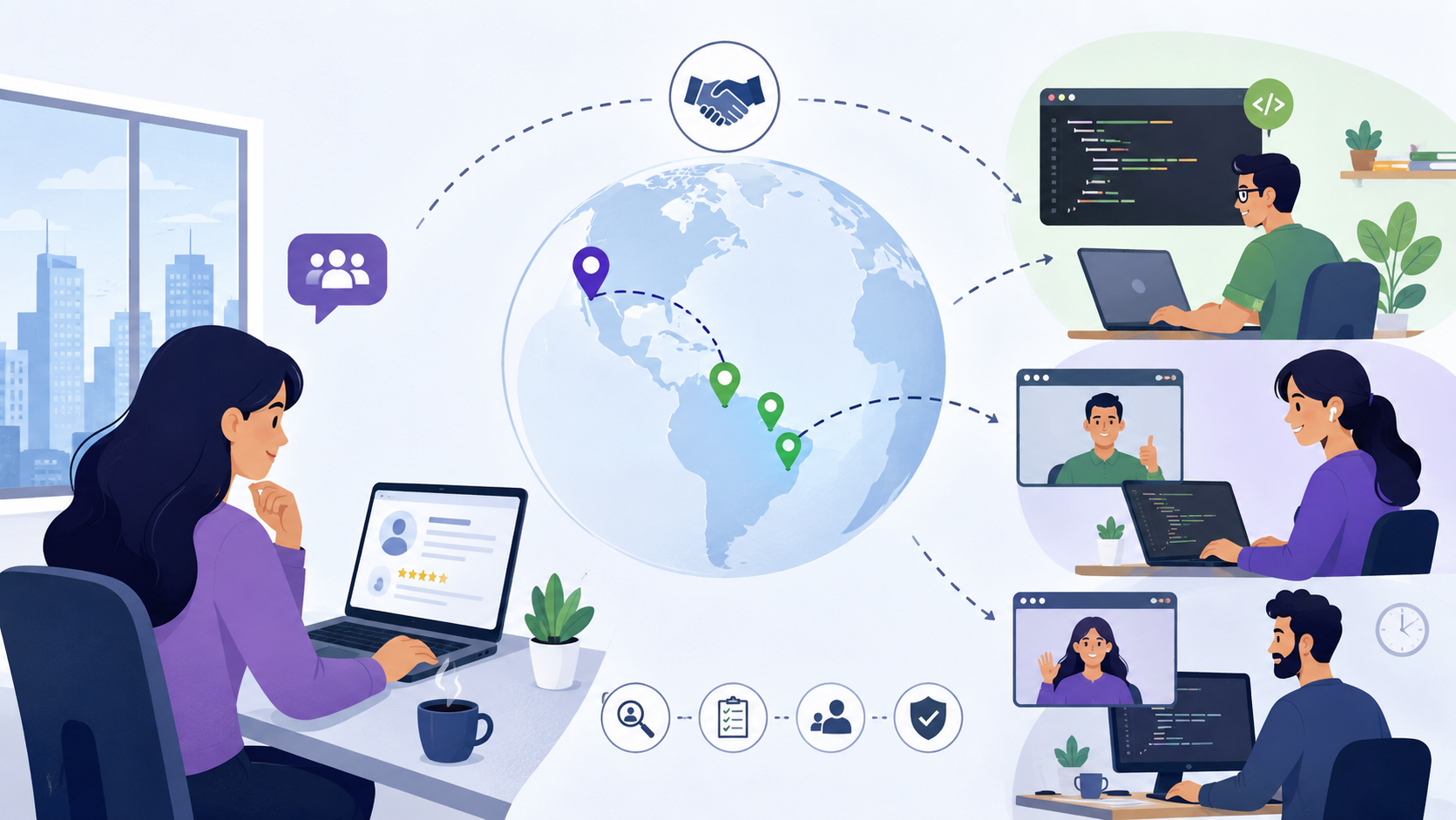
How to Hire Nearshore Developers (Without Getting Burned)
Hiring nearshore developers can be one of the smartest moves a US company makes — senior talent, real-time collaboration, and significant cost savings. It can also go badly if you approach it the wrong way. If you've been burned by an outside dev team before, you already know the difference matters.
Here's a practical guide to hiring nearshore developers who actually deliver.
Step 1: Get clear on what you need
Before you talk to any vendor, define the role precisely:
- Skills and seniority: Do you need a senior engineer who can architect and make decisions, or hands to execute a defined plan? (For most teams, seniority pays for itself.)
- The specific stack: React? Node? Python? Cloud (AWS, GCP)? Data or AI/ML?
- Engagement type: One engineer to fill a gap, or a full dedicated squad?
- Duration: A short project, or ongoing capacity?
The clearer your brief, the better the matches you'll get — and the faster.
Step 2: Prioritize timezone
The single biggest advantage of nearshore over offshore is the timezone overlap. A team in Latin America working US hours gives you same-day communication and real-time collaboration — the thing that makes or breaks day-to-day productivity.
When evaluating a partner, confirm their engineers actually work *your* hours, not just that they're geographically "nearby." Real-time overlap is the whole point.
Step 3: Insist on real vetting — and interview candidates yourself
This is where good and bad nearshore providers separate.
Ask any potential partner: who does your technical vetting? The strong ones vet candidates with experienced engineers or team leads — people who can actually assess technical depth — not just HR screeners or automated filters.
And make sure you interview and choose the engineers who'll join your team. A partner confident in their talent will welcome this. Be cautious of anyone who just sends you a body and says "trust us."
Step 4: Check English fluency and cultural fit
Technical skill isn't enough if communication breaks down. Look for engineers who are fluent in English, comfortable in agile workflows, and experienced working with US companies. They should integrate naturally into your Slack, Teams, Jira, and standups — not sit at arm's length.
One advantage of Latin American talent specifically: strong cultural alignment with US work styles, which means faster onboarding and fewer communication barriers than more distant regions.
Step 5: Look for a partner, not a vendor — this is the one that matters most
Here's the hard-won lesson: the engineer's resume gets you started, but the partner's model determines whether it lasts.
Many staffing agencies run on a churn model — place a body quickly, keep developer pay low, and refill the seat when the engineer inevitably leaves. That structural incentive produces exactly what you don't want: turnover, disengagement, and people who treat your product like someone else's problem.
What you actually want is a partner who:
- Staffs senior engineers who own outcomes and push back when something's wrong
- Communicates proactively — comes to you before you have to chase them
- Retains their people, so your team has continuity
- Treats your business like it matters to them
Ask about their engineer retention and how long their client relationships typically last. A partner with multi-year clients and low churn is telling you something a pitch deck can't.
Step 6: Start small, then scale
You don't have to commit to a full team on day one. Start with one senior engineer or a small scoped engagement, see how they integrate and deliver, and scale up once you've built confidence. A good partner will happily start this way — it's a sign they're confident in the fit.
Red flags to avoid
- Cost is the *only* thing they lead with
- They won't let you interview candidates
- Vague answers about who does the technical vetting
- No verifiable client references or reviews
- High developer turnover (or they dodge the question)
- Slow, misaligned communication *during the sales process* (it won't get better after you sign)
The bottom line
Hiring nearshore developers works beautifully when you get two things right: the right timezone (real-time overlap) and the right partner (senior, invested, low-churn). Get those, and you get a team that feels like your own — at a fraction of the cost of hiring locally.
Code Labs has been building nearshore staff augmentation teams for US companies for over 18 years, with client relationships that have lasted 5, 8, even 9 years. If you'd like to talk through what you need, get in touch.
Not sure whether nearshore or offshore is right for you? Read our guide: [Nearshore vs. Offshore Staff Augmentation](/blog/nearshore-vs-offshore-staff-augmentation).